

The US–Israel strategic partnership remains one of the most enduring and consequential alliances in modern international relations. In the current Middle East crisis, including direct confrontation involving Iran and Israel, Washington’s support for Israel has once again placed the alliance at the centre of global diplomacy.
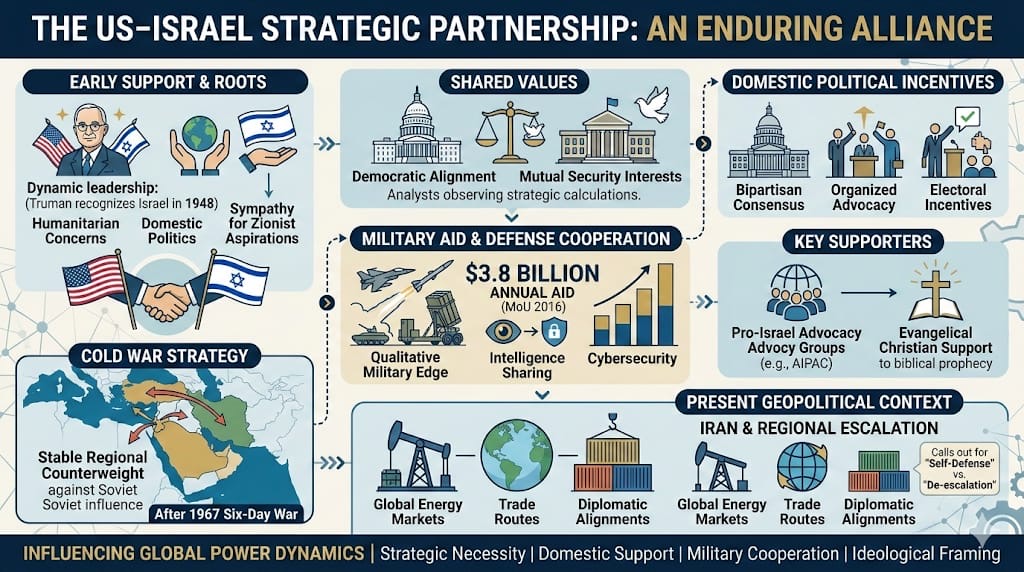
Early Support and the Roots of Zionist Backing
The United States recognized Israel within minutes of its declaration of independence in 1948 under President Harry Truman, according to official US State Department records. Early backing was shaped by humanitarian concerns after the Holocaust, domestic political pressures, and sympathy for Zionist aspirations.
Over time, moral and political recognition evolved into structured military and strategic cooperation, transforming a diplomatic gesture into a long-term geopolitical commitment.
“Shared Values” and Democratic Alignment
American administrations frequently describe Israel as a democratic partner in a volatile region. Official White House statements consistently frame the US–Israel strategic partnership as grounded in democratic governance, institutional stability, and mutual security.
However, analysts note that strategic and military calculations have always accompanied ideological alignment. The relationship rests not only on shared political systems but also on converging national interests.
Strategic Partnership During the Cold War
The relationship deepened significantly during the Cold War. As the Soviet Union gained influence across parts of the Arab world, Washington increasingly viewed Israel as a stable regional counterweight.
After the 1967 Six-Day War, US military assistance expanded rapidly. According to the US Congressional Research Service, Israel has received more cumulative US foreign aid than any other country since World War II.
This period firmly institutionalized the US–Israel strategic partnership within American foreign policy, embedding it into defense planning and regional strategy.
Military Aid and Defense Cooperation
The United States currently provides Israel approximately $3.8 billion annually under a 10-year Memorandum of Understanding signed in 2016. Official US government data shows this funding supports missile defense systems such as Iron Dome, joint military research, and advanced defense capabilities.
Cooperation also includes intelligence sharing, cybersecurity collaboration, and joint military exercises. These operational ties reinforce Israel’s qualitative military edge and anchor the modern dimension of the US–Israel strategic partnership.
Domestic Political Incentives
Support for Israel maintains strong bipartisan backing in Congress. Legislative voting patterns consistently favor military assistance packages and security resolutions supporting Israel.
Several domestic factors explain this continuity: historical bipartisan consensus, organized advocacy networks, and electoral incentives in key constituencies. Publicly supporting Israel has long been considered politically safe — and often politically advantageous — within American politics.
Evangelical Christian Support
Surveys by the Pew Research Center show strong pro-Israel sentiment among white evangelical Protestants in the United States. For many within this community, theological beliefs linked to biblical prophecy influence political perspectives.
This voting bloc has played a notable role in shaping Republican Party foreign policy positions, strengthening the domestic foundation of the US–Israel strategic partnership.
The Role of Pro-Israel Advocacy Groups
Organizations such as the American Israel Public Affairs Committee (AIPAC) engage lawmakers across party lines on issues related to US–Israel relations. Public lobbying disclosures show structured policy engagement with members of Congress.
While lobbying is a routine part of American governance, AIPAC’s visibility and organization often feature in debates over how foreign policy consensus is sustained.
Present Geopolitical Context: Iran and Regional Escalation
Amid rising tensions between Israel and Iran, Washington’s diplomatic and military posture reflects the durability of the alliance. US officials have reiterated Israel’s right to self-defense while also urging de-escalation.
Global reactions have been mixed. European governments are calling for restraint, while oil markets and financial systems are reacting to instability in the region. The US–Israel strategic partnership now influences not only Middle Eastern security calculations but also global energy markets, trade routes, and diplomatic alignments.
Why This Relationship Continues to Shape Global Power Dynamics
From early diplomatic recognition to Cold War alignment and modern defense cooperation, the alliance has evolved but remained structurally strong.
As geopolitical tensions involving Iran intensify, the US–Israel strategic partnership continues to influence decisions in Washington and beyond. Its foundations — strategic necessity, domestic political backing, military cooperation, and ideological framing — make it one of the most stable and consequential alliances in contemporary geopolitics.
Understanding this relationship is essential to interpreting US foreign policy, Middle Eastern diplomacy, and the broader shifts unfolding in global power structures.
Leave feedback about this