
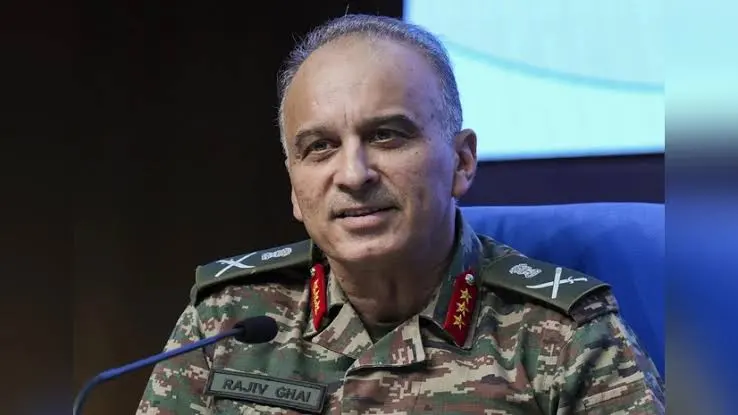
In one of the most candid briefings on cross-border military actions in recent times, Director General of Military Operations (DGMO) Lt Gen Rajiv Ghai disclosed that Pakistan suffered over 100 casualties along the Line of Control (LoC) during Operation Sindoor. The revelation comes as India’s response to the deadly Pahalgam terror attack, which claimed 26 civilian lives earlier this year.
Speaking on Tuesday, Lt Gen Ghai noted that Pakistan’s own actions inadvertently exposed the scale of their losses. “On August 14, Pakistan’s independence day, they released a list of posthumous awards. The unusually high number of honours clearly reflected the extent of their casualties — over 100,” he said, adding that India’s actions were well-calibrated and anticipatory.
Without directly naming Pakistan’s army chief, Asim Munir, the DGMO said, “It was evident that the Pakistan Army leadership was under immense pressure. Reviving their image was a priority — and as has often been the case, they turned to aggression along the LoC. What they did was cowardly, but expected.”
#WATCH | Delhi | Director General Military Operations Lt Gen Rajiv Ghai says, “… The fact that the Pakistan army and its chief were under duress at the time is known to everybody. There was a need for him to revive not only his image, but that of the Pak army itself. The best… pic.twitter.com/BLaxgaAuYR
— ANI (@ANI) October 14, 2025
A Fusion of Precision and Diplomacy
Describing Operation Sindoor as “a fusion of military precision and diplomatic agility,” Lt Gen Ghai highlighted how the campaign was not merely a tactical strike but part of a broader national response.
“This was about informational superiority, economic leverage, and diplomatic control,” he explained. “We immediately suspended certain provisions of the Indus Water Treaty of 1960 after the Pahalgam attack to send a strong message. Our operations remained controlled, non-escalatory, and transparent — to maintain India’s credibility.”
#WATCH | Delhi | Director General Military Operations Lt Gen Rajiv Ghai says, “88 hours is what it took for the enemy to come and ask for a cessation of hostilities. You’re well aware of that. For that call to be made by my counterpart, then. We achieved our political and… pic.twitter.com/iBciGUvFxQ
— ANI (@ANI) October 14, 2025
Targeted Retaliation
The DGMO confirmed that nine terror hubs, including key Lashkar-e-Taiba facilities, were struck during Operation Sindoor. The precision-led missions, he said, demonstrated India’s readiness and resolve. The offensive ended on May 10, following diplomatic talks between New Delhi and Islamabad.
Regarding the perpetrators of the Pahalgam attack, Lt Gen Ghai revealed that “it took us 96 days to track and neutralise all three. When found, they were exhausted and malnourished — evidence of constant pursuit. For us, it’s never a matter of ‘if’ but ‘when’ they will be found.”
#WATCH | Delhi | Director General Military Operations Lt Gen Rajiv Ghai says, “The Indian Navy was also in action… The Navy had sailed into the Arabian Sea and when the DGMO spoke, they were very well poised. Had the enemy decided to take it any further, it could have been… pic.twitter.com/lK5dhQkHY6
— ANI (@ANI) October 14, 2025
A Shift in India’s Response Doctrine
The revelation around Operation Sindoor underscores a significant shift in India’s counter-terror strategy — one that combines swift military retaliation with strategic restraint. As Lt Gen Ghai framed it, “We aimed to make our message clear — India will respond decisively, but responsibly.”
With Pakistan’s internal disclosures inadvertently confirming the toll, Operation Sindoor now stands as a pivotal example of India’s ability to integrate diplomacy, intelligence, and precision warfare — setting a new template for how future provocations may be met.
Leave feedback about this