

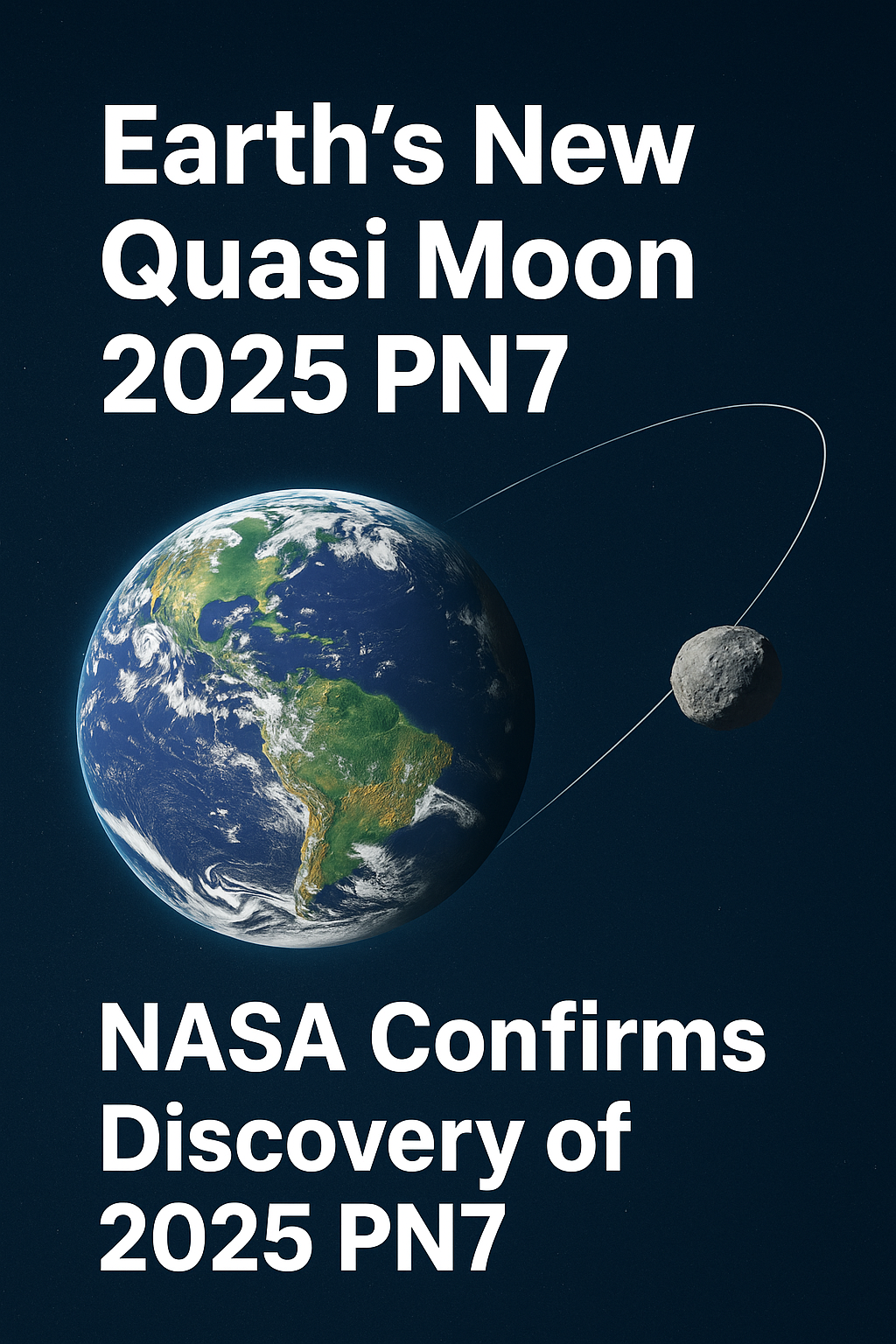
In a fascinating astronomical discovery, NASA has officially confirmed Earth’s new quasi moon 2025 PN7, a small asteroid that moves in near-perfect harmony with our planet around the Sun. The finding has sparked excitement among scientists, as it provides fresh insight into the dynamic relationship between Earth and small celestial bodies sharing its orbital path.
Astronomers at the University of Hawaii detected the object during a Pan-STARRS 1 sky survey earlier this year. Measuring between 18 and 36 meters in width, the asteroid is about the size of a small building, yet its orbit makes it an intriguing object of study.
What makes Earth’s new quasi moon 2025 PN7 unique is that it does not orbit Earth like the Moon. Instead, it circles the Sun on a trajectory nearly identical to Earth’s, creating the illusion that it is accompanying our planet. NASA scientists describe it as “a cosmic runner keeping pace beside Earth, always nearby but never touching.”
How Long Will It Stay?
Based on NASA’s data, Earth’s new quasi moon 2025 PN7 has been near our orbit for nearly 60 years and could continue to do so until about 2083. After that, gravitational forces from the Sun and other planets will likely push it away into deeper space.
Even at its closest approach, 2025 PN7 remains a safe distance from Earth — roughly four million kilometers away, which is almost ten times farther than our Moon. This means it poses no collision risk and will remain a harmless visitor in Earth’s neighborhood.
Why Scientists Are Excited
Researchers are keen to study this quasi moon to better understand how small asteroids interact with Earth’s gravity. Because 2025 PN7 follows a nearly identical orbit to our planet, it offers a rare opportunity to observe orbital resonance and test future mission concepts.
NASA believes that studying such quasi moons could help in developing technologies for asteroid mining, resource extraction, and planetary defense strategies. These co-orbital objects are also ideal for testing spacecraft navigation in near-Earth environments.
A Natural Laboratory for the Future
The discovery of Earth’s new quasi moon 2025 PN7 highlights how much remains to be explored in our solar system. Even in regions as familiar as Earth’s orbit, small bodies can remain undetected for decades. This asteroid’s long stay until the 2080s offers astronomers decades of observation time to track its behavior and learn how similar bodies evolve over time.
As scientists continue to monitor 2025 PN7, it stands as a reminder that space around Earth is far more dynamic and complex than once thought. While it may not be a true moon, this cosmic companion offers valuable lessons about our planet’s place in the vast solar system.
Leave feedback about this