
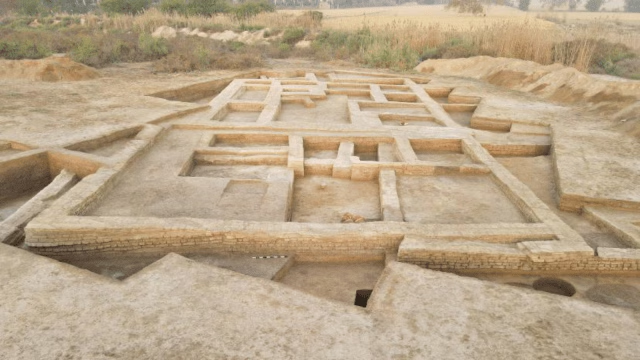
In a significant move to safeguard India’s ancient heritage, the Haryana government has declared two Harappan sites in Bhiwani district as protected archaeological monuments. The sites, located in the villages of Mitathal and Tighrana, date back over 4,400 years and have been instrumental in understanding the Bronze Age civilization that once thrived in the Indo-Gangetic region.
Why Has Haryana Declared These Sites as Protected?
The notification, issued on March 13 by the Haryana Department of Heritage and Tourism, aims to prevent further destruction of these sites, which were previously treated as agricultural land by villagers. Under the Haryana Ancient and Historical Monuments and Archaeological Sites and Remains Act, 1964, the state archaeology department will now fence off the sites and deploy security personnel to ensure their preservation.
What Do the Excavations Reveal?
Archaeological excavations at Mitathal—conducted in 1968 and later in 2016, 2020, 2021, and 2024—have shed light on the town planning, arts, and crafts of the Harappan civilization. Key findings include:
-
Copper and bronze implements, indicating a sophisticated metallurgical culture.
-
Beads, bangles, and terracotta objects, suggesting a flourishing artisan economy.
-
Painted red pottery with pipal leaf and geometric motifs, reflecting advanced craftsmanship.
-
Evidence of fortified settlements, pointing to organized urban planning.
Meanwhile, Tighrana holds significant post-Harappan remains, revealing insights into the evolution of human settlement in the region. Archaeologists suggest that the site was first occupied by Chalcolithic agricultural communities around 2,400 BCE. These early settlers, known as Sothians, built mud-brick houses with thatched roofs and relied on agriculture and cattle domestication.
How Does This Impact Heritage Conservation?
Historians and archaeologists have welcomed the decision, emphasizing that official recognition was long overdue. Dr. Narender Singh Parmar, Head of the History and Archaeology Department at the Central University of Haryana, highlighted the urgent need for protection, stating that continued agricultural use had already damaged parts of the sites.
With Haryana’s latest step towards heritage conservation, experts believe these sites will provide critical insights into the transition from pre-Harappan to post-Harappan cultures. The discovery of green carnelian bangles and bead-making materials at Tighrana suggests an advanced jewelry industry, further underscoring the economic sophistication of ancient settlers.
‘Liberation Day’ Looms: Trump Plans Tariff Shake-Up, India in Spotlight
Leave feedback about this