
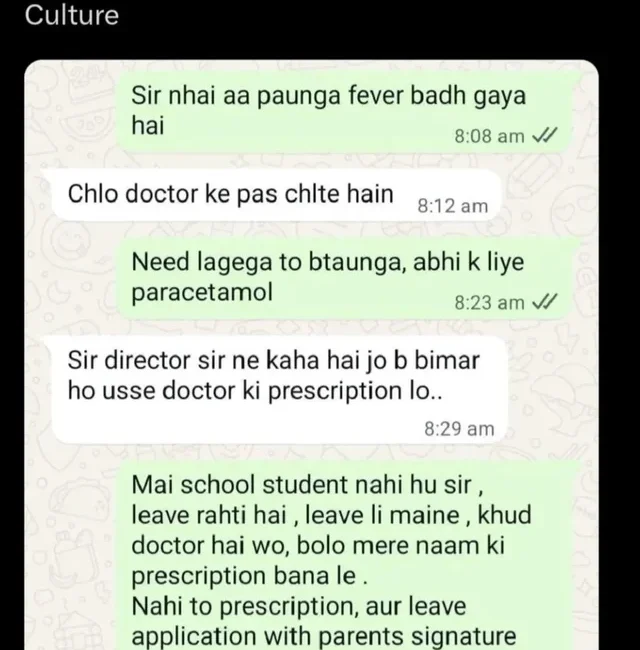
Mumbai: A viral WhatsApp conversation between an employee and his manager has become the latest symbol of how young professionals setting boundaries are changing India’s traditional work culture. The chat, originally shared on Reddit, highlights how Gen Z workers are no longer afraid to say no when they are unwell or overworked.
The conversation begins with the employee informing his boss, “Sir, nhai aa paunga fever badh gaya hai,” meaning he would not be able to come to work due to a high fever. The manager immediately replied, “Chlo doctor ke pas chlte hai,” suggesting they visit a doctor together. The employee politely responded, “Need lagega to btaunga, abhi k liye paracetamol,” explaining he would go if necessary but had taken medicine for now.
The only right way to respond!
byu/vishal_gandhii inindiameme
Things escalated when the manager insisted that the company director required a doctor’s prescription for anyone taking leave. The employee’s bold reply has since been praised across the internet. He wrote, “Mai school student nahi hu sir, leave rahti hai, leave li maine, khud doctor hai wo, bolo mere naam ki prescription bana le. Nahi to prescription, aur leave application with parents signature nahi hai mera pass. Aur mai abhi rest kar raha hu, msg ya call ka reply nahi karunga.”
This confident response struck a chord with thousands of young workers who see it as a moment that perfectly captures young professionals setting boundaries in the workplace. The Reddit post titled “Only Gen Z can fix the toxic Indian work culture” has received thousands of upvotes and hundreds of supportive comments.
Social media users applauded the employee for standing his ground. One commenter wrote, “I love it. This is the way.” Another added, “No company can force you to submit a doctor’s certificate on a one-day sick leave.” Many others pointed out that employers who micromanage sick days often create more stress than productivity.
Experts believe this incident highlights a broader generational change. Today’s workforce values mental health, rest, and respect as much as performance. The rise of young professionals setting boundaries is a response to years of overwork, unpaid expectations, and rigid hierarchies. Unlike previous generations, Gen Z workers are more vocal about burnout and demand fair treatment.
The viral chat also shows a deeper conflict in Indian offices. While older managers often view constant availability as loyalty, younger employees see personal time as essential for well-being. This cultural shift means the concept of young professionals setting boundaries is not just about saying no but about redefining what professionalism looks like in modern India.
To bridge the generational gap, experts suggest that employers must:
-
Build a culture of trust instead of control.
-
Respect employee health without unnecessary proof or pressure.
-
Train managers to adapt to evolving workplace values.
-
Promote open communication where both sides can express expectations clearly.
Leave feedback about this