
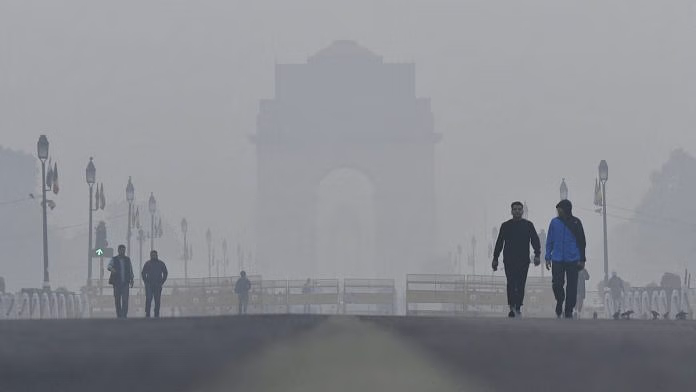
New Delhi– As India contends with one of the world’s most severe air pollution crises, the conversation is no longer just about rising particulate matter—it’s about the credibility of the very data that informs the country’s fight. In Delhi, where air pollution routinely reaches hazardous levels, the government’s decision to install six new Continuous Ambient Air Quality Monitoring Stations (CAAQMS) in low-pollution regions like JNU and Delhi Cantonment, instead of in hotspots like Anand Vihar and Okhla, is sparking serious concerns about transparent air quality monitoring.
This skewed placement of sensors not only clouds the reality of urban air toxicity but also undermines public health, policy planning, and the trust that citizens place in institutions meant to protect them.
Misplaced Priorities in a Smog-Filled Sky
Despite having over 1,000 monitoring stations nationwide, many are inefficiently deployed. Installing high-cost monitors (each costing over ₹1 crore) in clean zones produces artificially low average readings. Anand Vihar, for example, recorded an AQI of 426 in November 2023, while Delhi Cantonment measured just 172—an alarming contrast that exposes the fault lines in India’s monitoring network.
This misallocation is not merely technical negligence; it represents a systemic failure. Data distortion, or “data dressing,” creates a false narrative, delaying pollution responses under mechanisms like the Graded Response Action Plan (GRAP) and weakening the effectiveness of the National Clean Air Programme (NCAP).
Structural Gaps and Public Disengagement
The Delhi Pollution Control Committee (DPCC), tasked with managing this complex infrastructure, remains critically understaffed—only a handful of environmental engineers oversee air quality in a megacity of over 30 million. Operational hurdles such as power outages and poor maintenance further compromise data reliability.
Public engagement, meanwhile, remains minimal. Citizens are neither educated on how to interpret the Air Quality Index (AQI) nor given access to real-time platforms. Without public pressure, accountability falters, and pollution control efforts lose momentum.
Regional Politics and a National Health Emergency
The impact of transboundary pollution exacerbates this challenge. Stubble burning in Punjab and Haryana contributes up to 24% of PM2.5 levels in Delhi during the winter, yet rural and peri-urban areas remain under-monitored. This makes the job of the Commission for Air Quality Management (CAQM) exponentially harder, reducing coordinated action to mere paperwork.
According to the 2024 IQAir report, India is now the fifth most polluted country globally, with a PM2.5 average of 50.6 µg/m³—ten times the WHO limit. Byrnihat, a small town on the Assam-Meghalaya border, has emerged as the most polluted city in the world. Nationally, air pollution causes 2.1 million premature deaths annually, behind only China.
India, France Ink ₹63,000 Crore Pact for 26 Rafale M Fighters
From Health to Economy: The Toll of Dirty Air
The consequences of poor air quality ripple across sectors:
-
Health: PM2.5 exposure is linked to respiratory diseases, cardiac issues, asthma, and even gastrointestinal disorders. Vulnerable groups such as children, the elderly, and low-income communities suffer the most.
-
Economy: India loses 3% of its GDP every year due to pollution-related health costs and lost productivity.
-
Energy: Pollution reduces solar energy efficiency, potentially leading to a 2.3% drop in photovoltaic performance by 2050 and a loss of at least 840 GWh annually.
The Way Forward: Building Trust Through Transparent Air Quality Monitoring
To restore credibility and impact, India must adopt a strategic overhaul:
-
Scientific Deployment: Install CAAQMS based on GIS pollution mapping to prioritize hotspots. Research partnerships can guide optimal placement.
-
Institutional Strengthening: Boost staffing and funding for DPCC and State Pollution Control Boards. Equip them with advanced training in tech and analytics.
-
Public Platforms: Launch real-time, independent AQI dashboards, similar to judicial data grids. Revamp CPCB’s Sameer app to provide hyper-local alerts.
-
Cross-State Collaboration: Empower CAQM to coordinate rural and urban efforts. Promote alternatives like Pusa Decomposer for stubble management.
-
Technological Integration: Use AI-based forecasting, satellite imagery, and low-cost sensor networks to widen coverage and prediction accuracy.
Toward a Data-Driven Air Quality Framework: Aligning Monitoring with Policy and Public Health Goals
Transparent air quality monitoring is not a bureaucratic checkbox—it is the cornerstone of India’s environmental and public health strategy. In a country where 13 of the 20 most polluted cities are found, the misuse or manipulation of data is not just a technical glitch—it’s a national emergency. The time to invest in integrity, innovation, and inclusivity in pollution monitoring is now. As UPSC aspirants study environmental governance, this is one real-world case where policy meets public health, and data must serve truth, not convenience.
Coastline Correction: India’s Shoreline Gets 3,500 km Longer
New Heights for Defence Tech: DRDO Tests Stratospheric Surveillance Airship
Leave feedback about this